
Most of us are familiar with Handel’s “Hallelujah” chorus, made famous throughout the ages. But did you know that “Messiah” in its entirety is a 2 1/2 hour-long worship song?
The oratorio was originally composed by George Frideric Handel in 1742. In a time period of less than a month, he penned the musical score, set to lyrics that came directly from the King James Bible and the Coverdale Psalter (a book of Psalms set to music).
This amazing work has certainly left its mark on Western music, even pop culture references of today. Over the past few weeks, as I’ve listened to this in its entirety, I’ve been brought to tears by the beauty of the story of the Bible, which is the story of Jesus, being brought to life through music. And I think if we stop and slow down enough to look at the stunningly beautiful lyrics, we will be challenged, exhorted, and encouraged by what it says about us and about our Christ.
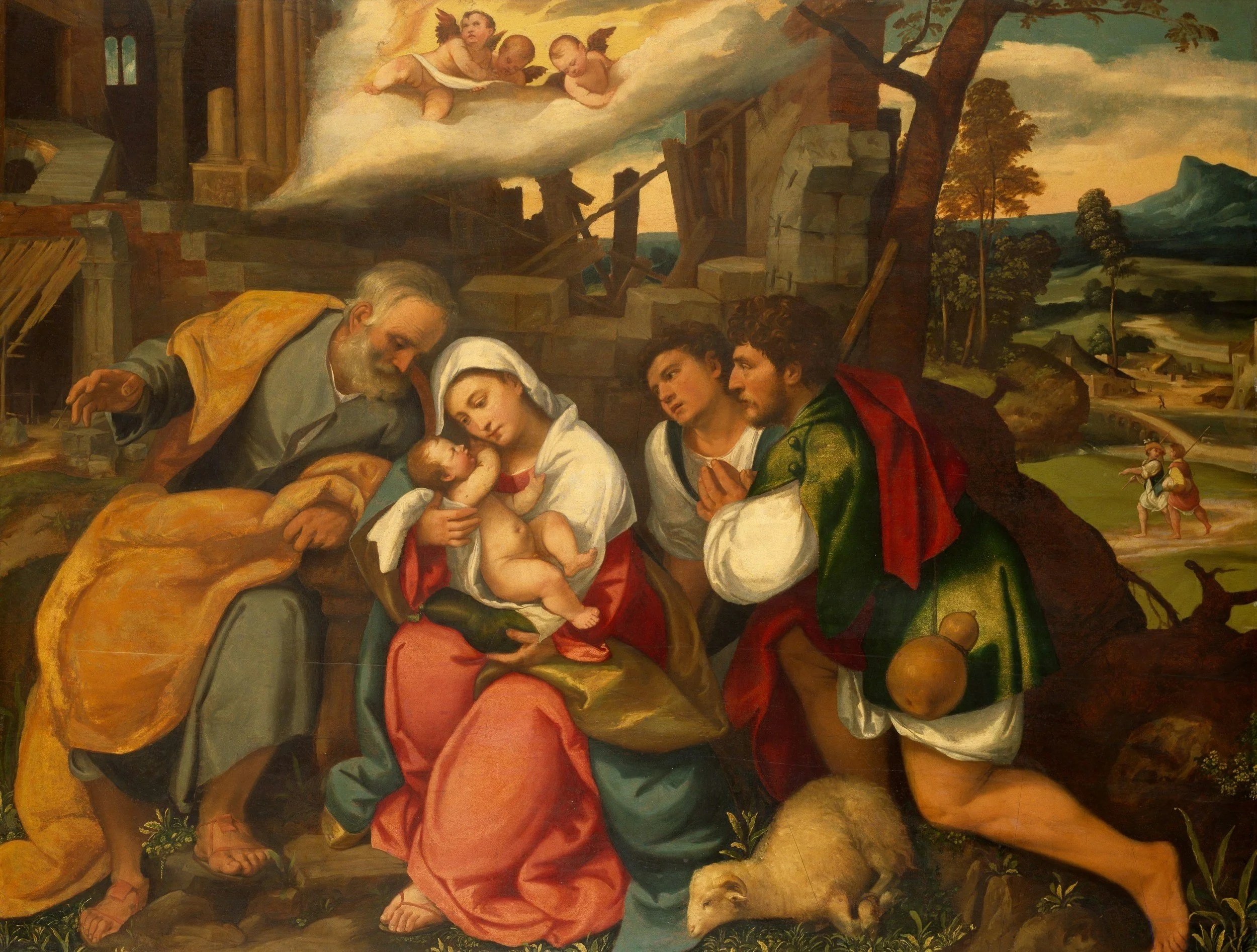
The Adoration Of The Shepherds, 1540 Oil On Panel.
The first movement is all about the prophecies of Christ’s birth, from the book of Isaiah.
Comfort ye, comfort ye, my people, saith your God: Speak ye comfortably to Jerusalem, and cry unto her, that her warfare is accomplish’d, that her iniquity is pardoned. (Isaiah 40:1)
Why do the people of Jerusalem, God’s people, need comfort? Because they have been taken captive by Babylon for their sin of idol worship. Yet, God never stops loving them or providing a way for them to be made righteous and holy. He says: Look! I am creating a way for you to be made right with Me.
The voice of Him that crieth in the wilderness: Prepare ye the way of the Lord, make straight in the desert a highway for our God. (Isaiah 40:2-3)
This well-known prophecy would be fulfilled 700 later, when John the Baptist was born. His parents, Zechariah and Elizabeth, were old and barren. But, just like Abraham and Sarah, old age and barrenness were only a minute detail, nothing more. Against this backdrop of well-worn prayers, of desperation and barrenness, the God of Hope bursts onto the scene.
The people that walked in darkness have seen a great light. And they that dwell in the land of the shadow of death, upon them hath the light shined. (Isaiah 9:2)
This prophecy was not just true for the nation of Israel but for the whole world. A Light would come, giving illumination to people everywhere who walked in darkness (Ephesians 2).
The climax of the first half of the oratorio says this:
For unto us a Child is born, unto us a Son is given and the government shall be upon His shoulder, and His name shall be called: Wonderful Counsellor, The Mighty God, The Everlasting Father, The Prince of Peace! (Isaiah 9:6)
The choir goes on to extol the wonders of Christ’s birth, detailing the appearing of the angels to the shepherds, saying:
“Glory to God in the highest, and peace on earth, good will toward men.” (Luke 2:14)
Handel could’ve stopped there. But he’s far from finished.
Part 2 of the oratorio starts out with the theme of “Christ’s Passion.” Just listen to the lyrics:
Surely He hath borne our griefs and carried our sorrows; He was wounded for our transgressions, He was bruised for our iniquities; the chastisement of our peace was upon Him. (Isaiah 53:4–5)
Going on to quote from Isaiah 53, Handel describes how the Roman soldiers mocked Jesus. They spat on Him and pulled out His beard; yet, “He hid not his face from shame and spitting.”
So the perfect Son came to die for us. He was scorned, scourged, mocked, tortured, and crucified for us, providing the Perfect Atonement we needed to finally be made righteous with God. As the Gospel is preached, and the sound of it goes to the ends of the earth, Handel quotes from the book of Romans:
How beautiful are the feet of them that preach the gospel of peace, and bring glad tidings of good things! (Romans 10:15)
But what are we, the children of Adam, doing with these beautiful tidings of great joy? Do we gaze at the Christ in wonderment and awe, like the shepherds when they heard good tidings? No, the world has rejected the Gospel. Just as in the parable of the tenants, the vineyard owner expected the tenants of the vineyard (who were renting it!) to give him his due payment. But the vineyard tenants killed the servants of the king. The owner said, I will send my Son. Surely they will not reject him. But the tenants killed the Son and tried to take the inheritance for themselves (Mark 12:1-12).
Handel looks to Psalm 2 to describe the world’s rejection of Christ:
Why do the nations so furiously rage together, and why do the people imagine a vain thing? The kings of the earth rise up, and the rulers take counsel together against the Lord and His anointed. (Psalm 2:1–2)
The nations rise up and rage against God the Father and His Son; yet all of this is in vain. Why? Because…
Thou shalt break them with a rod of iron; Thou shalt dash them in pieces like a potter’s vessel. (Psalm 2:9)
And what is our response to the justice of the LORD being carried out? That the final ultimate victory over sin, Satan and death is coming, and there is no one able to stop it?
The famous “Hallelujah” chorus:
Hallelujah, for the Lord God Omnipotent reigneth. The Kingdom of this world is become the Kingdom of our Lord and of His Christ; and He shall reign forever and ever. King of Kings, and Lord of Lords. Hallelujah! (Revelation 19:6, 11:5, 19:16)
As believers, what are we believing in? That even when it seems like God is silent, we can have certainty in His final, ultimate victory.
For:
Since by man came death, by man came also the resurrection of the dead. For as in Adam all die, even so in Christ shall all be made alive. (I Corinthians 15:21–22)
And:
If God be for us, who can be against us? Who shall lay anything to the charge of God’s elect? It is God that justifieth: Who is he that condemneth? It is Christ that died, yea rather, that is risen again, who is at the right hand of God, who makes intercession for us. (Romans 8:31, 8:33–34)
Since we know that God kept His promise to His children, that He would give an heir to Abraham, that Abraham’s descendants would outnumber the stars in the sky, and that the eventual heir of the promise would be Christ…
Since we know that Christ really came, His birth being heralded by shepherds and angels on a hilltop outside of Bethlehem…
Since we know that the promise of a Savior, who would come once and for all the crush the head of the serpent…
Since we know that every promise is “yes and amen” in Christ, we can have FULL confidence in and worship the Son, born to us this Christmas.
Worthy is the Lamb that was slain, and hath redeemed us to God by His blood, to receive power, and riches, and wisdom, and strength, and honour, and glory, and blessing. Blessing, and honour, glory, and pow’r be unto Him that sitteth upon the throne and unto the Lamb for ever and ever. (Revelation 5:9, 12–13)
Here is the full recording of Handel’s Messiah. I hope it brings you great tidings of great joy this Christmas!